
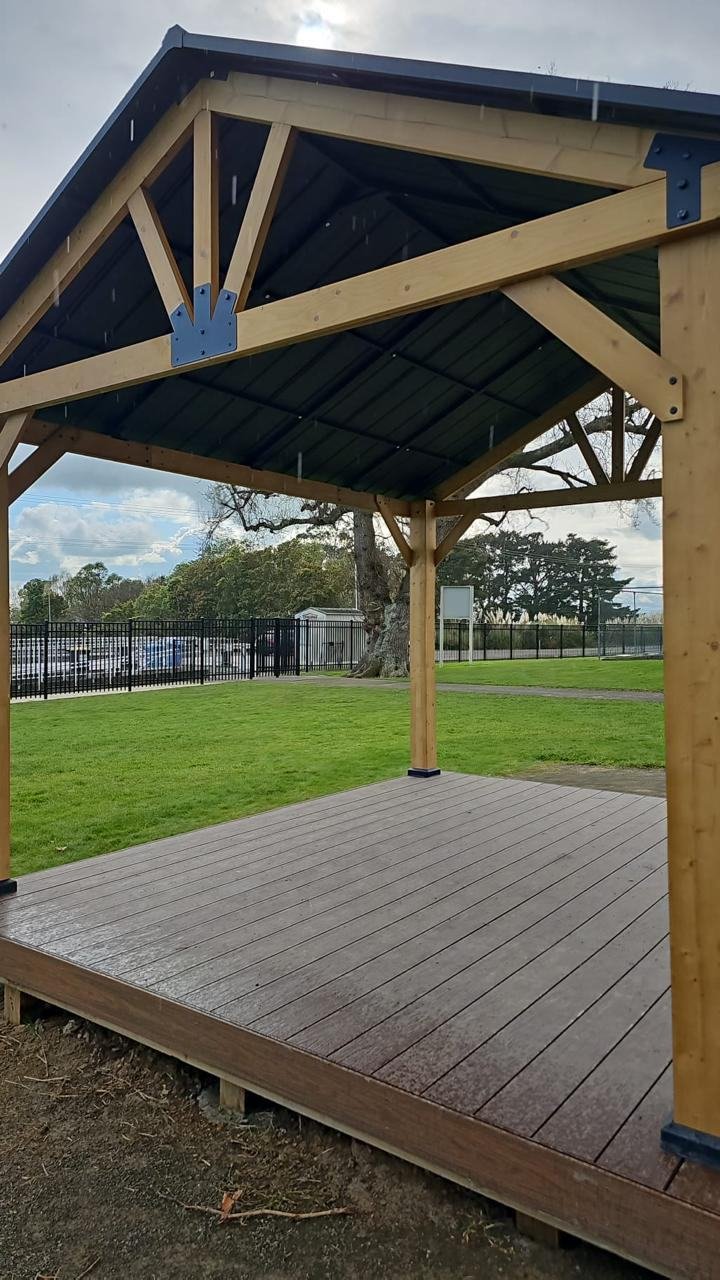
A pergola is an outdoor structure made of upright posts carrying beams overhead. It defines an outdoor room over a deck, patio or garden path, and it can be left open to the sky or given a roof. In New Zealand the word gets used for everything from a timber frame with a climbing vine to a fully waterproof louvre roof, which is why quotes for a "pergola" can describe very different products.
This guide explains what a pergola is, the main types you will come across, and how to work out which one suits the way you want to use your outdoor space.
The basic parts of a pergola
- Posts carry the load down to footings in the ground or to a deck structure.
- Beams span between the posts and hold up whatever sits on top.
- The top is either open rafters or battens, or a roof: solid sheeting, polycarbonate panels or opening blades.
- The connection is either freestanding, standing on its own posts, or attached to the house along one side.
Open pergolas
The traditional pergola has an open top of rafters or battens. It gives a feeling of enclosure and some dappled shade, especially once plants grow over it, but it does not keep rain off. Open, unroofed pergolas are also one of the structures listed as exempt from building consent in Schedule 1 of the Building Act, which is part of their appeal. They suit gardens and paths more than outdoor living areas you want to use in all weather.
Roofed pergolas
Most New Zealanders who ask for a pergola really want cover from rain and sun. Adding a roof turns the frame into a usable outdoor room, and there are three common ways to do it:
- Solid metal roof. Our Metal Pergola uses steel posts and beams, galvanised and powder-coated, with corrugated metal roofing for full shade and rain cover. It can be built freestanding or attached to the house.
- Translucent canopy roof. An Elite Canopy is a 6063-T6 aluminium frame with 6 mm polycarbonate roof sheets in clear or tinted. It keeps the rain off while letting light through, with 99.9% UV protection.
- Opening louvre roof. Opening Louvres have motorised aluminium blades that open to the sun or close against rain, with a rain sensor that closes them automatically. With the blades closed the roof gives 100% UV protection.
Pergola, canopy, carport or awning?
The names overlap. A canopy is usually a roofed pergola with a translucent roof. A carport is the same idea sized and positioned for a vehicle. An awning is a roof attached to the side of a building. The name matters less than three questions: does it need to keep rain off, how much light do you want underneath, and does it attach to the house or stand alone? Our pergola guide compares the options side by side.
Materials
Timber pergolas look natural but need regular staining or painting. Steel is strong and suits a solid roof. Aluminium does not rust and suits glazed and louvre systems. The pergola materials guide covers timber, steel and aluminium in more detail.
Do you need building consent?
An open pergola is generally exempt. Once it has a roof, the rules for awnings and carports in Schedule 1 apply, and size limits decide whether consent is needed. Our building consent guide sets out the national rules and links to each council.
Choosing the right type
- Want shade and a garden feature only? An open pergola works.
- Want year-round cover with light coming through? Look at a canopy.
- Want full shade and a solid roof over a spa or kitchen? A metal pergola fits.
- Want sun on winter days and cover when it rains? An opening louvre roof gives both.
We have designed and installed more than 5000 outdoor projects from five branches: Auckland, Tauranga, Wellington, Christchurch and Dunedin. If you are not sure which type suits your space, book a free measure and quote and we will look at the site with you.