
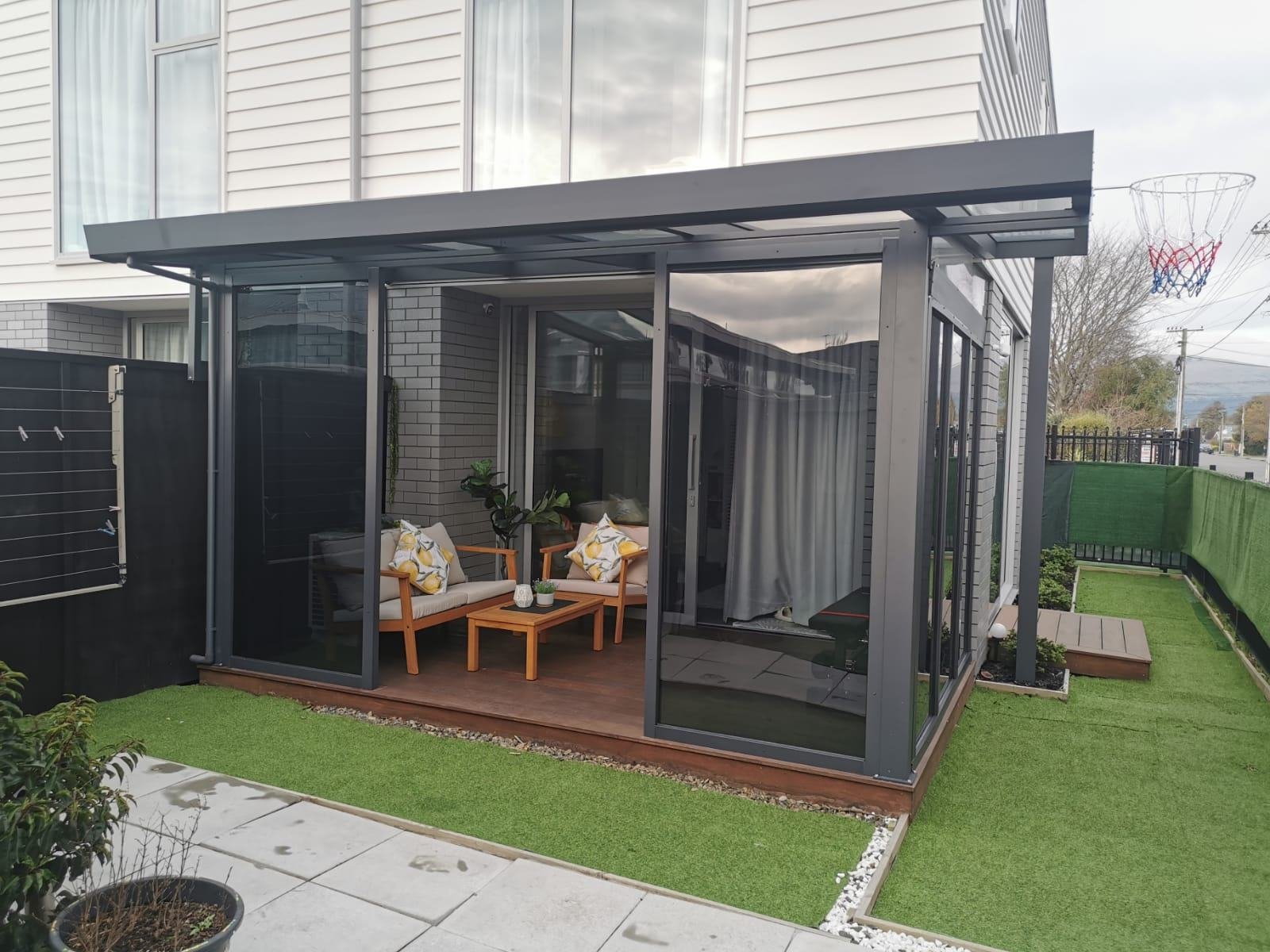
"Fixed panels" isn't one product - it's a category covering at least four genuinely different systems that all do the same basic job (enclosing the side of an already-covered space) in different ways. Confusing them is the most common mistake people make when comparing quotes. Here's what each one actually is.
The four products under "fixed panels"
- Fixed glass panel - a permanent glass panel, the simplest option, good for a side that never needs to open. Around $450 per m² excl. GST.
- Fixed louvre shutter - a stationary louvre panel that provides partial airflow by design, without moving parts. Around $580 per m² excl. GST.
- Sliding louvre shutter - lets you manually adjust airflow and light by sliding the panel, without fully opening the side. Around $600 per m² excl. GST.
- Frameless sliding glass door - gives you a fully openable wall when you want the space open-air, closed like a glass room the rest of the time. Around $600 per m² excl. GST.
Which one actually fits your situation
If you just need permanent wind protection on one side and never plan to open it, a fixed glass panel is the simplest and cheapest option. If you want airflow control without full opening, a louvre shutter (fixed or sliding) is the better fit. If you want the option of a fully open wall on a good day and a closed one when it's not, a frameless sliding glass door is worth the extra cost over a fixed panel.
How fixed panels combine with a canopy or louvre roof
Fixed panel systems are almost always an add-on to an existing roofed structure - a canopy or louvre roof - rather than a standalone product. They enclose one or more sides of that structure. If you're planning both together, it's worth designing the roof and the panels as one project rather than adding panels as an afterthought, since the framing needs to account for both from the start.
Frame and glazing considerations
As with any outdoor structure, aluminium framing resists corrosion far better than steel, particularly in coastal conditions. For glass panels and sliding doors, ask about the glass thickness and safety rating - not all glass used in outdoor structures is the same grade.
Are glass panels safety-rated?
They should be - ask specifically whether the glass used is toughened/safety glass rated for the application, particularly for sliding doors that get regular contact. Don't assume this by default; confirm it in writing as part of your quote.
Fixed panel vs a sunroom: what's the actual difference?
A fixed panel encloses one side of an already-roofed space - it's an add-on, not a standalone room. A sunroom is a complete, fully enclosed and glazed room in its own right, usable as genuine indoor floor space year-round. If you already have a roof and want to block wind or rain from one side, you need fixed panels. If you want a genuine new room, you need a sunroom - see our full sunroom comparison for more detail.
Maintenance
- Clean glass with a standard glass cleaner, avoiding abrasive pads.
- Keep sliding tracks free of grit so shutters and doors move smoothly.
- Check seals annually, especially before winter.
Warranty
Get the warranty period in writing regardless of which fixed panel product you choose - Impact Outdoors backs its installations with a 5-year roof warranty and 10-year structural warranty.
Get a real quote
Impact Outdoors installs fixed glass panels, louvre shutters and frameless sliding doors across Auckland, Wellington, Christchurch, Tauranga and Dunedin. Get a free onsite quote for your specific configuration, or explore Fixed Panels.