
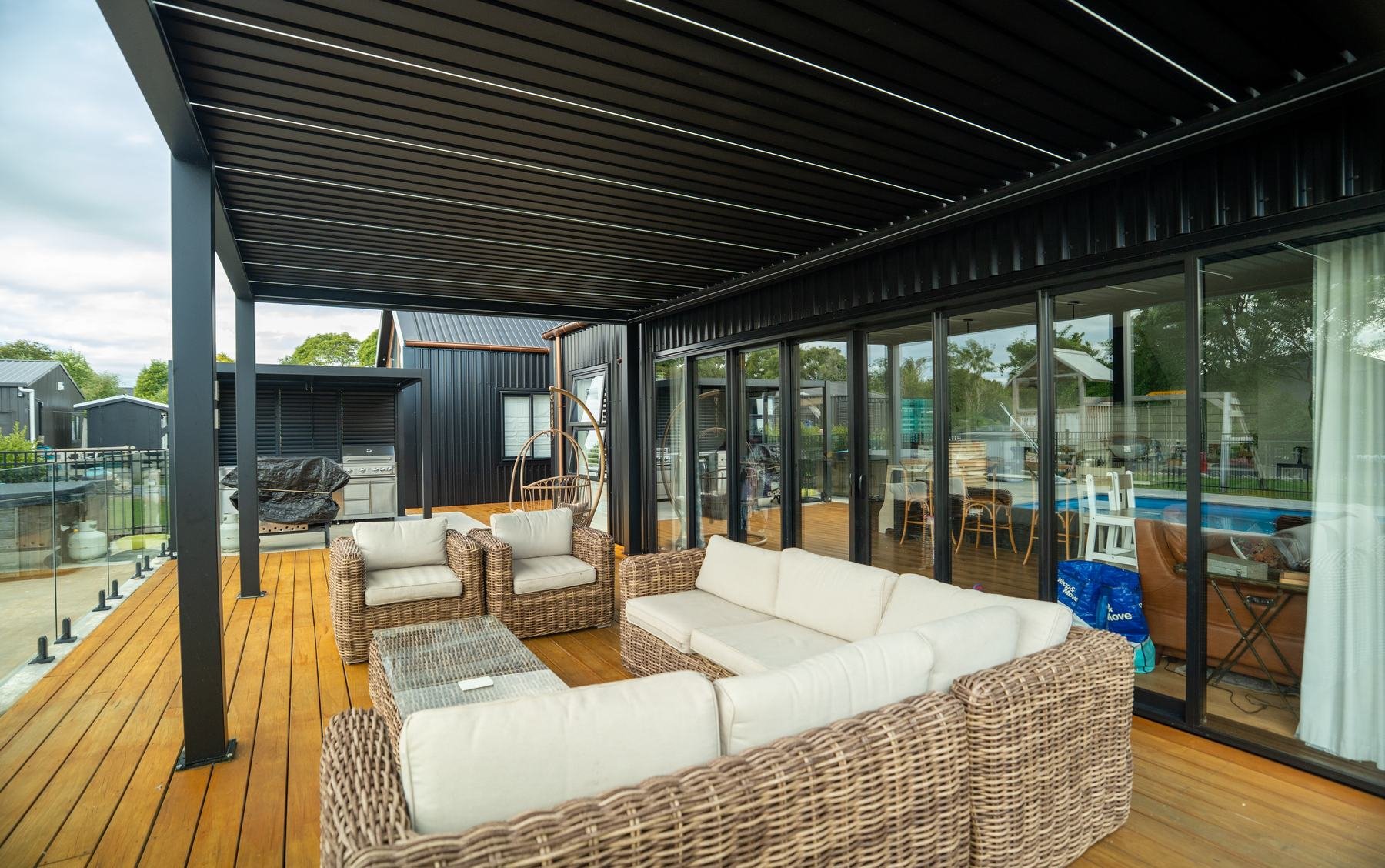
Opening louvre roofs and fixed pergolas (canopies) both cover an outdoor space, but they solve genuinely different problems and sit at very different price points. Here's a real, detailed comparison — not just "it depends."
Fixed canopy: simpler, cheaper, always covered
A fixed-roof canopy is a permanent, weatherproof structure — polycarbonate roofing on an aluminium frame, no moving parts. It's always in the same state: covered. Pricing runs from around $320 per m² for an economy build up to around $420 per m² for an elite finish, excl. GST. Because nothing is motorised, there's nothing to service beyond basic cleaning.
Opening louvre roof: adjustable, but a bigger investment
An opening louvre roof uses motorised aluminium blades you control at the touch of a button — closed flat in rain, angled for shade, or fully open to the sun. That flexibility costs more: manual louvre systems run around $700 per m² excl. GST, and automatic (motorised) systems around $900 per m², plus the electrical work a fixed canopy doesn't need.
Side-by-side: what actually differs
- Cost: Fixed canopy $320-$420/m²; opening louvre $700-$900/m² excl. GST.
- Flexibility: Fixed canopy is always covered; louvre roof adjusts to conditions on demand.
- Maintenance: Fixed canopy needs only cleaning and a fixings check; a louvre roof has a motor, drainage channels and pivot points to keep serviced.
- Consent complexity: Both depend on the specific structure, but the electrical work for a motorised system is an extra factor to plan for.
- Lifespan: Both use aluminium framing and are built to last well beyond their warranty period with basic care - fewer moving parts on a fixed canopy is one reason it needs less attention over time.
Which one actually fits your space
Choose a fixed canopy if you mainly want reliable, year-round shelter for an outdoor dining or living area you'll use in most weather, and want to keep costs and moving parts to a minimum.
Choose an opening louvre roof if you want the same space to work as an open-air entertaining area on a clear day and a sheltered room the moment it turns, and the extra cost is worth that flexibility to you.
Can you add a louvre roof later, after starting with a fixed canopy?
Not by converting the existing structure — a fixed canopy's frame isn't designed to carry a motorised blade system. If there's a real chance you'll want the opening option later, it's worth having that conversation with your installer before the first structure goes up, not after.
Maintenance: what each one actually needs
Fixed canopy: rinse debris off every few months, keep gutters at the roof edge clear, check fixings annually (especially after storms).
Opening louvre roof: keep blade pivot points free of debris so they open and close smoothly, have the motor and drainage system checked periodically (blocked drainage channels are the most common issue), and test the remote/app control regularly rather than only when something's already wrong.
Do louvre roofs actually leak?
A properly engineered and installed louvre roof shouldn't leak when closed — the blades overlap and drain into a channel system built for exactly that. Ask specifically how the drainage is designed and get it demonstrated, not just described.
Warranty applies to both
Whichever you choose, get the roof warranty and structural warranty periods in writing. Impact Outdoors backs both Elite Canopies and Opening Louvres with a 5-year roof warranty and 10-year structural warranty.
Compare both, properly
Impact Outdoors installs both Elite Canopies and Opening Louvres across Auckland, Wellington, Christchurch, Tauranga and Dunedin. Run your own dimensions through our price calculator for an instant estimate on either option, or get a free onsite quote to compare properly.